Institute for Protein Physics

Fundamental Methods


(C.1) Physical Perturbation Method

(C.2) Double Deconvolution (DDCL) Method

(C.3) Analysis method using equilibrium and/or kinetic models


(C.1) Physical Perturbation Method

This is a molecular design method (1998) for improving protein properties. Based on the three-dimensional structure, amino acids that affect the physical environment (electrostatic potential, fluctuations, etc.) that are assumed to affect the physical properties of the target protein are determined, and by replacing these amino acids, the physical environment is changed, resulting in changes to the target protein properties. This method can be applied to proteins whose three-dimensional structure is known (or can be estimated). Using this method, we have succeeded in significantly improving the catalytic activity of the metalloprotease thermolysin. For details, please refer to "1-2 Higher functionality by physical perturbation method" in"Molecular design of biological nanomachines" (Kyoritsu Shuppan,2001).

C.2) Double Deconvolution (DDCL) Method

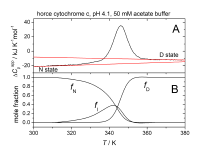
If the thermal transition of a protein is reversible, the enthalpy change and Gibbs energy change can be evaluated from the associated heat capacity change (temperature dependence) without assuming a model. Based on this, we published an analysis method for the case of unimolecular reactions (1987) and cases including dissociation and association (1988). If the calorific value change associated with the thermal transition is evaluated by DSC (differential scanning calorimetry), the change in thermodynamic quantity can be evaluated by this method using Windows software (DDCL3, distributed free of charge). If you would like to use this, please feel free to contact us atinfo@proteinphys.org.

(C.3) Analysis method using equilibrium and/or kinetic models

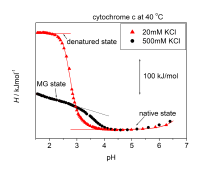
Even in calorimetry, data analysis is performed assuming an appropriate model for factors other than temperature (such as pH, salt concentration, pressure, etc.) or irreversible changes. Even in this case, accurate evaluation is possible by making the most of the advantages of calorimetry. In many cases, analysis using a model involves the use of nonlinear least squares methods. For details on model selection, please refer to "3.3 Data Analysis in Biocalorimetry" in "Calorimetric Measurement and ThermalAnalysis Handbook, Third Edition" (2020, Maruzen Publishing).